
Introduction
Along the red-laterite coastline that stretches from Goa down through the Konkan belt of coastal
Karnataka, an ancient art form clings quietly to the walls of temples, ancestral homes, and community
halls. Kaavi art — named after the vivid rust-red pigment derived from laterite — is one of India’s most
distinctive mural traditions. Bold, graphic, and deeply narrative in character, it translates mythology,
folklore, and everyday life into sweeping white figures painted against a fiery ochre-red ground.
Unlike many Indian mural traditions that require elaborate scaffolding, gilded pigments, or imported
materials, Kaavi is resolutely of the land. Its colours come literally from the ground beneath the artist’s
feet; its tools are often improvised; its stories are those of the communities it adorns. This very
rootedness gives Kaavi a peculiar resilience — and, as the world turns toward authenticity and
sustainability in art, an unexpected contemporary relevance.
This article traces the full arc of Kaavi art: its origins in a pre-colonial coastal culture, its techniques and
materials, its social and spiritual life, its economic dimensions, and the exciting possibilities it holds for
artisans, designers, entrepreneurs, and policymakers in the decades ahead.
History and Origins
Ancient Roots
The precise antiquity of Kaavi is difficult to pin down because it was, for most of its history, a living
practice rather than a catalogued heritage. Art historians place its active tradition at least five to six
centuries old, with some scholars arguing for roots stretching back to the early medieval period of the
Kadamba and later Vijayanagara empires, whose cultural sway shaped much of coastal South India
between the 10th and 16th centuries CE.
The earliest datable Kaavi murals surviving today are found in the interiors of temple complexes and
aristocratic houses (wadas) along the Goa–Karwar–Mangalore belt. These murals depict scenes from the
Ramayana, Mahabharata, Puranic episodes, and the exploits of local deity cults such as those of Bhairi,
Vetaal, and the Saptamatrikas — a distinctly coastal Deccan pantheon blending Shaiva, Vaishnava, and
tribal elements.
Colonial Period and Near Disappearance
The Portuguese colonization of Goa beginning in 1510, and the subsequent expansion of Portugues
influence along the Konkan coast, brought profound disruptions. The Inquisition destroyed numerous
temples and suppressed folk religious practices. Many Kaavi-bearing structures were demolished; artists
fled inland or south into the Kanara territories. The art survived most robustly in regions that remained
outside direct Portuguese control — particularly in the princely states and chieftaincies of coastal
Karnataka where the Keladi Nayakas and later the Kingdom of Mysore maintained relative autonomy.
By the 19th century, with the spread of colonial modernity and the introduction of chemical paints and
lime-based plasters that did not accept the laterite wash, Kaavi began its long recession. The art became
increasingly confined to older structures, and the number of practitioners dwindled as younger
generations migrated to urban centres or moved into more commercially viable occupations.
20th-Century Documentation and Revival
Serious documentation of Kaavi began only in the latter half of the 20th century, largely through the
efforts of individual art historians, cultural organisations such as the Goa Heritage Action Group, and
later, the Karnataka Chitrakala Parishath. The Indian National Trust for Art and Cultural Heritage
(INTACH) conducted surveys in the 1990s and 2000s that identified surviving Kaavi sites and living
practitioners.
The revival gained momentum in the 2010s as both state governments — Goa and Karnataka — began
to recognise the art’s potential for cultural tourism and community identity. Government craft boards,
NGOs, and design schools began integrating Kaavi into curriculum and livelihood programmes, reaching
a new generation of practitioners for the first time in decades.
Historical Note: Some of the finest surviving Kaavi murals in Goa can be found at the Shri
Mahalaxmi Temple in Bandora, the Shantadurga Temple in Ponda, and in old Portuguese-era houses
in Quepem district where pre-conversion murals were plastered over and later revealed during
restoration.
Materials and Processes
Kaavi is, at its heart, a two-colour art. The ground is the rich reddish-brown of laterite — achieved eithe
by using laterite-based plaster directly on the wall, or by applying a wash of laterite slurry over a lime
base. Against this warm red ground, the artist draws and paints in white, traditionally using a lime wash
made from shell lime (conch or oyster shells burnt and slaked) blended with binding agents such as
jaggery water, raw rice paste, or the sticky resin of certain trees.
The result is a bold chromatic contrast: white lines and forms leap out against the deep red ground with
the clarity of a woodblock print. This graphic quality is not accidental — it reflects an aesthetic tradition
deeply comfortable with bold silhouette, confident outline, and minimal tonal modelling.
Preparation of the Wall
Traditional Kaavi begins with the preparation of the surface — a process that can take several days for a
large wall. The wall is first cleaned and any loose material removed. A base coat of lime or laterite
plaster is applied and left to cure. Depending on the desired finish, multiple coats may be applied. In the
finest traditional work, the final surface is burnished while still moist, giving it a slight sheen that lends
depth to the painted figures.
The laterite wash — called the ‘kaavi’ itself, from which the art takes its name — is applied while the
plaster is still slightly damp in some traditional techniques, allowing partial absorption that improves
adhesion. In other approaches, it is applied over a fully dried surface as a thin slip. The choice depends
on the artist’s training, regional practice, and the porosity of the base plaster.
Pigments and Binding Media
Beyond the core red-and-white palette, skilled Kaavi artists may introduce secondary colours using
natural mineral and organic sources. Black comes from lamp soot or charred coconut shell. Earthy
yellows and ochres come from specific clay deposits found along the coast. A deep indigo derived from
the indigo plant was historically used for accent lines, though it is now rarely seen in practice. Green
from copper-based minerals appears in older murals but is difficult to source authentically today.
Binding media are equally important to the durability of the work. Traditionally, the white lime paint is
mixed with organic binders — most commonly a preparation of raw rice water or jaggery dissolved in
water — that both improve adhesion and prevent chalking. Some regional traditions add neem leaf
extract as a mild fungicide, enhancing the mural’s resistance to coastal humidity and monsoon moisture.
Tools and Application
Kaavi artists traditionally work with handmade brushes — bundles of coconut fibre, the fibrous root tips
of particular grasses, or feathers bound to bamboo handles. These implements produce the slightly
rough, textured line quality that distinguishes authentic Kaavi from imitations executed with modern
brushes. The boldness and occasional irregularity of the line is not a flaw but a signature quality,
reflecting the direct, confident hand of an experienced artist.
The composition is typically laid out freehand, without underdrawing, though highly experienced artists
may use a thin charcoal line as a guide for complex narrative panels. Figures are defined by contour first,
then filled in with wash, and finally given internal detail through secondary linework. Human and animal
figures in Kaavi tend to be stylised rather than naturalistic — large almond eyes, elongated limbs,
expressive gestures borrowed from classical South Indian iconographic conventions.
A Mix of Art Forms and Techniques
One of the most remarkable aspects of Kaavi is the way it absorbs and synthesises multiple art streams.
It is simultaneously a mural tradition, a graphic art (with its emphasis on bold outline and flat colour), a
narrative art (functioning much like a visual scripture in temple settings), a folk art (practised and
appreciated within local communities rather than exclusively by court artists), and an architectural art
(inseparable from the buildings it adorns).
Scholars have noted formal parallels between Kaavi and other Indian mural traditions — particularly the
Warli art of Maharashtra, the Pattachitra of Odisha, and the Saura art of Andhra Pradesh — suggesting a
shared aesthetic genealogy rooted in pre-Sanskritic tribal and folk traditions of peninsular India. At the
same time, Kaavi shows clear absorptions from classical temple iconography, Deccan miniature painting
conventions, and even, in some later examples, the symmetry and floral vocabulary of Portuguese and
Indo-Portuguese architectural decoration.
This synthetic quality is both a historical fact and a creative resource. Contemporary practitioners who
understand Kaavi’s multi-layered origins are free to bring it into dialogue with other visual languages —
graphic design, textile printing, digital illustration — without betraying its essence.
Technique Note: Modern practitioners increasingly use mineral-based pigments and acrylic binders
to improve colour permanence and ease of application on non-laterite surfaces, while retaining the
traditional colour palette and figure vocabulary. Purists debate this adaptation, but most scholars
view it as a pragmatic evolution consistent with Kaavi’s long history of material adaptation.
Social and Cultural Significance
Art as Sacred Threshold
In its original contexts, Kaavi was never purely decorative. Murals at temple entrances and sanctum
walls served as visual scripture — a way of making mythology legible to a largely non-literate
population. The stories painted on the walls of a village temple functioned as both entertainment and
instruction, situating devotees within a shared cosmological narrative. Attending a festival at a Kaavi-
adorned temple meant entering a complete visual world in which one’s own community was reflected
and consecrated.
The placement of Kaavi art at thresholds — over doorways, on entrance walls, framing sacred niches —
invests it with apotropaic significance. The fierce images of guardian deities, multi-armed goddesses,
and mythological heroes are not simply illustrative; they are understood to protect the space they
occupy. This belief system makes the conservation of Kaavi murals a matter not just of aesthetics but of
living religious practice for many communities.
Community Identity and Caste Traditions
Kaavi art has historically been practised by specific communities — most notably the Chitari and
Navayath communities in coastal Karnataka, and various artisan communities in Goa. The art was
transmitted through family lineages, with techniques and compositional secrets passing from parent to
child as part of a broader system of hereditary craft knowledge. This meant that the art was deeply
embedded in community identity: to paint Kaavi was to belong to a particular social world, to carry a
specific set of obligations and privileges.
As the caste-based craft economy weakened through the 20th century, this exclusivity gradually
dissolved — creating both loss (of specialised knowledge held within tight communities) and
opportunity (as the art became accessible to practitioners from any background). Today’s Kaavi revival is
characterised by a more open pedagogy, with workshops, design schools, and online platforms training
artists from diverse communities.
Women and Kaavi
Women have played a complex and often underacknowledged role in the Kaavi tradition. In many
coastal Karnataka homes, women were responsible for the maintenance and renewal of threshold
murals and domestic ritual paintings — the everyday Kaavi that framed the family’s annual religious
calendar. This domestic Kaavi, less formally studied than its temple counterpart, was a site of
considerable female creative agency, with individual practitioners developing personal stylistic
signatures within the tradition’s conventions.
Contemporary revival efforts have increasingly centred women as primary practitioners and economic
beneficiaries of Kaavi’s commercial development. Women’s self-help groups in Uttara Kannada district
and in several Goan villages have adopted Kaavi as a livelihood art, producing products ranging from
painted tiles to decorated fabric. This shift represents a significant realignment of gender roles within
the tradition.
Kaavi and Oral Culture
Kaavi does not exist in isolation from the oral traditions of the coast. The images on a temple wall are
understood in relation to the songs, stories, and ritual performances that accompany festivals. A mural
depicting the legend of Bhairi or the birth of Parashurama is part of a multimedia cultural event in which
the painted image, the chanted text, the performed mask dance, and the sacred music reinforce one
another. To view Kaavi only as visual art is to miss its full significance as one thread in a larger cultural
fabric.
Economic Significance
Traditional and Transitional Economy
For most of its history, Kaavi artists were compensated through the traditional jajmani system — a form
of patron–artisan relationship in which temple committees, landlords, and wealthy families provided
seasonal employment, grain payments, and social support in exchange for the artist’s services. This
system provided stability but limited financial independence, and it largely collapsed through the mid-
20th century as the rural economy transformed.
The current economic moment for Kaavi is one of genuine transition. A small but growing number of
artists are finding sustainable livelihoods through a diversified mix of revenue streams: heritage
restoration contracts, cultural tourism, craft product sales, institutional training, and commissions for
contemporary applications. The challenge is to scale these opportunities without exploiting practitioners
or diluting the art.
Heritage Tourism and Cultural Economy
Goa’s position as one of India’s premier tourist destinations creates an obvious economic opportunity
for Kaavi. The state’s heritage structures — old temples, ancestral mansions, colonial-era buildings —
attract visitors specifically interested in cultural and historical experience. A well-presented Kaavi mural
at a heritage site functions as both a cultural attraction and a marketing asset for the surrounding
economy.
Coastal Karnataka, while less developed as an international tourist destination, has seen growing
domestic cultural tourism, particularly around the Tulu Nadu region’s distinctive folk culture.
Yakshagana performances, Bhuta Kola rituals, and coastal heritage trails are drawing visitors who are
also interested in visual arts. Kaavi fits naturally into this ecosystem, and several local entrepreneurs
have begun offering Kaavi-focused experiences — artist studio visits, live demonstration workshops, and
hands-on painting sessions — as tourism products.
Craft Products and Design Applications
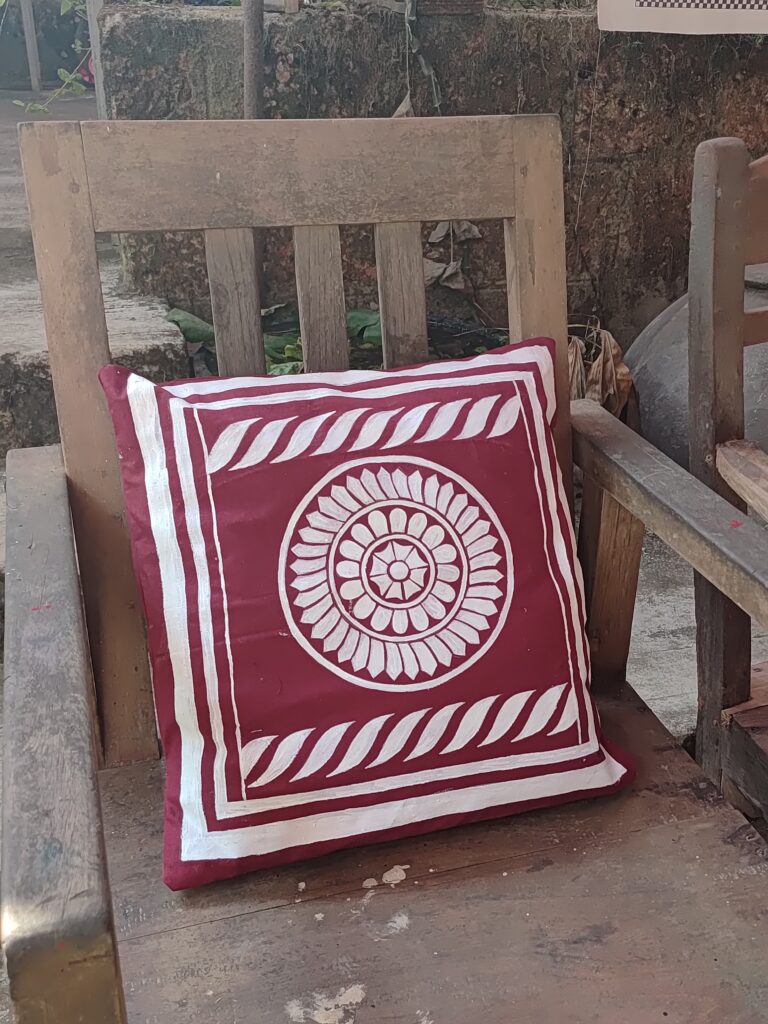
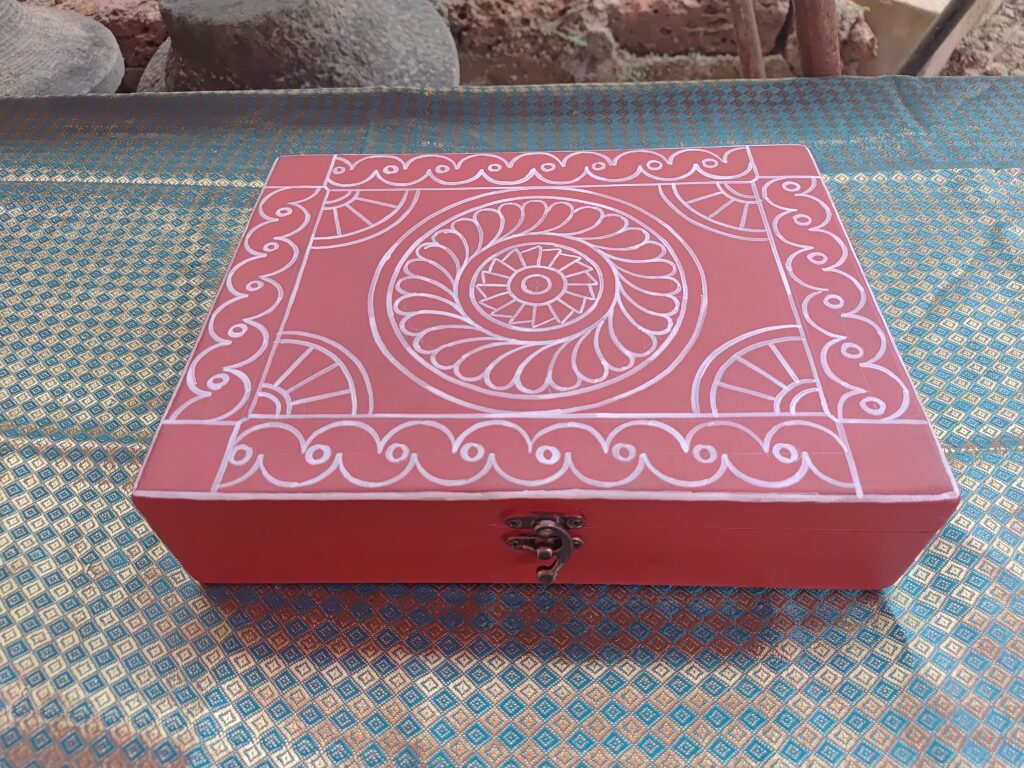
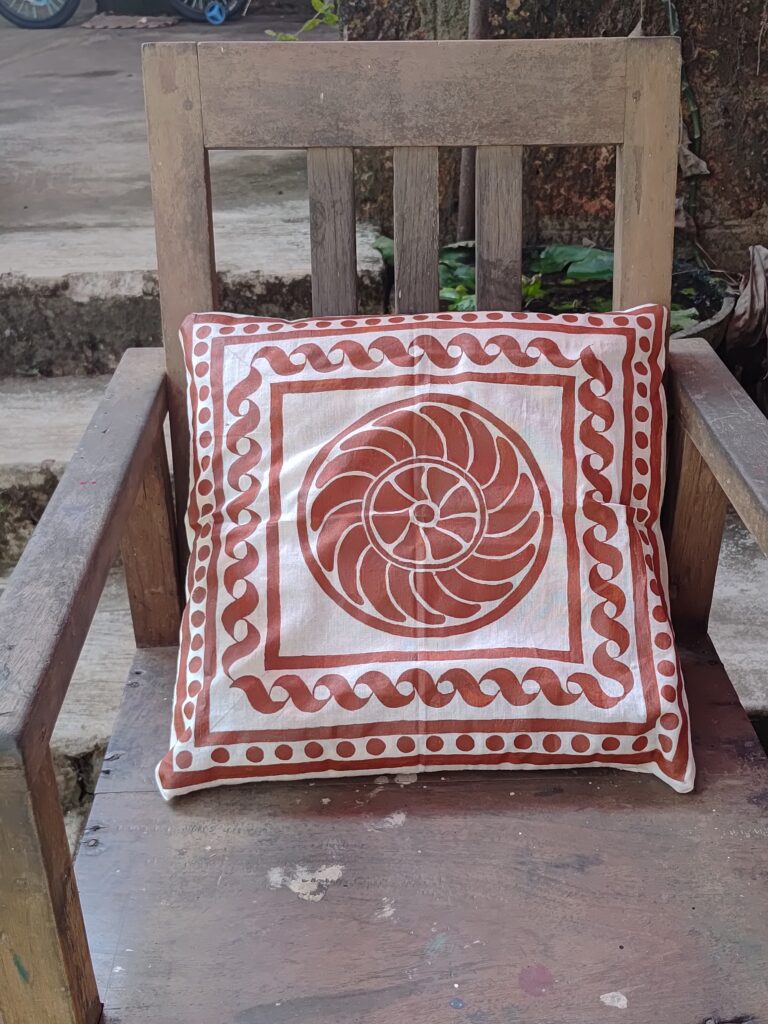
Perhaps the most immediately scalable economic opportunity lies in craft products. Kaavi motifs have
been successfully applied to a wide range of surfaces and objects: terracotta and ceramic tiles, cotton
and silk textiles (through block-printing or hand-painting), leather goods, wooden furniture and panels,
stationery and paper products, and homeware. These products find markets in domestic craft fairs,
government emporiums such as Cauvery and Goa’s Craft Complex, and increasingly through e-
commerce platforms.
The design appeal of Kaavi — bold, graphic, rooted, and authentically Indian — makes it particularly
well-suited to the growing segment of the Indian middle class that seeks decor and fashion products
with cultural depth. Global design trends toward handmade, locally sourced, and narratively rich
products also position Kaavi well in export markets. Several Goa-based designers have already
incorporated Kaavi elements into fashion collections shown at national and international platforms.
Market Insight: Craft products carrying a credible Kaavi heritage story — with documented artisan
provenance and traditional technique certification — can command significant price premiums over
generic regional craft items. This ‘story premium’ is one of the most important economic levers
available to Kaavi practitioners and their commercial partners.
Future Possibilities and Job Creation
The Scale of Opportunity
The economic potential of Kaavi art, properly developed, extends well beyond individual artisans selling
painted products at a craft fair. A fully developed Kaavi economy could encompass heritage
conservation professionals, cultural tourism entrepreneurs, design industry collaborators, educators,
digital content creators, and policy advocates. The art is a platform, not just a product — and platforms,
when well-designed, create ecosystems of employment.
Heritage Conservation and Restoration
Dozens of heritage structures along the Konkan coast contain Kaavi murals in varying states of decay.
The systematic conservation of these sites requires trained muralists capable of working in traditional
techniques — a genuinely skilled profession that combines art, chemistry, architectural knowledge, and
cultural sensitivity. Currently, there are very few trained Kaavi conservation specialists in India, meaning
that much conservation work is done either by under-skilled local contractors or not at all.
A structured training programme — perhaps a two-year certificate course run jointly by a heritage
institution and a design college — could produce a cohort of qualified Kaavi conservators who would
find immediate employment on government and private heritage projects. The Archaeological Survey of
India, the state archaeology departments of Goa and Karnataka, and private temple trusts all represent
potential employers for such professionals.
Design Industry Integration
Indian and global design industries represent arguably the largest scale employment opportunity for
Kaavi. Interior designers working on hospitality projects — hotels, restaurants, resorts — are
increasingly seeking authentic regional art for large-scale wall treatments. Kaavi, with its dramatic scale
and strong visual identity, is exceptionally well-suited to these applications. A single luxury hotel mural
commission can provide months of work for a team of artists.
Textile designers and fashion houses represent another significant opportunity. Kaavi motifs translate
beautifully to block-print textiles, and the growing global market for traditional Indian textiles with
cultural heritage credentials creates real export potential. Collaboration between Kaavi artists and
textile entrepreneurs — with fair-trade pricing and genuine artisan credit — could create significant
rural livelihoods, particularly for women.
Digital and New Media Applications
The distinctive visual vocabulary of Kaavi — its bold geometry, its confident line, its mythological
iconography — translates powerfully into digital media. Kaavi-inspired graphic design, motion graphics,
illustration, and game design are emerging creative fields that can draw on the tradition while creating
new kinds of employment for digitally literate young practitioners. Several animation studios have
already experimented with Kaavi aesthetics for short films and cultural content projects.
NFT and digital collectibles platforms represent a newer opportunity that several traditional art
communities across India are beginning to explore. A well-curated series of Kaavi digital artworks,
presented with proper cultural context and artisan attribution, could find buyers in global digital art
markets willing to pay for the combination of aesthetic quality and cultural authenticity.
Education, Training, and Knowledge Economy
Every revival art creates a demand for its own pedagogy. Kaavi workshops, residential intensives, online
courses, educational kits for school students, and artist residency programmes all represent viable
economic activities that keep the tradition alive while generating income. The ‘experience economy’ —
in which consumers pay not for products but for meaningful participatory experiences — is growing
rapidly, and Kaavi is well-positioned to serve it.
Goa’s art colleges, Manipal Academy of Higher Education, and the Karnataka Chitrakala Parishath all
have the institutional infrastructure to offer accredited Kaavi training programmes. Connecting these
institutions with working practitioners — ensuring that teaching brings income to traditional artists
rather than displacing them with academic teachers who lack hands-on lineage — is the key design
challenge.
Government and Policy Levers
The most impactful economic interventions for Kaavi are likely to come through policy. Geographic
Indication (GI) tagging of Kaavi art — similar to the GI tags already granted to Kondapalli toys,
Channapatna crafts, and dozens of other Indian traditional arts — would provide legal protection for the
name and the tradition, preventing cheap imitations from undercutting authentic practitioners. The
Handicrafts Development Commissioner and the respective state craft boards need to be engaged in
pursuing this.
Public procurement — requiring government buildings, airports, cultural centres, and tourist
infrastructure in Goa and Karnataka to commission Kaavi murals — would create predictable
institutional demand for the art. This is not a novel idea: Rajasthan has long used public procurement to
sustain its miniature painting and blue pottery traditions with considerable success. A modest allocation
in state infrastructure budgets could sustain dozens of full-time Kaavi artists.
Finally, the Mahatma Gandhi National Rural Employment Guarantee Scheme (MGNREGS) and similar
programmes could, with appropriate modifications, support the documentation and painting of Kaavi
art in rural panchayat buildings and community spaces — combining employment guarantee with
cultural preservation in a genuinely synergistic way.
Summary of Employment Opportunities
▸ Heritage conservation specialists and mural restorers
▸ Cultural tourism entrepreneurs and guide-practitioners
▸ Craft product makers: textiles, ceramics, leather, wood, paper
▸ Interior design muralists for hospitality and residential projects
▸ Kaavi-inspired graphic designers for digital and print media
▸ Educators, workshop facilitators, and residency programme hosts
▸ Digital artists and motion graphic designers drawing on Kaavi vocabulary
▸ Policy advocates, GI tag administrators, and craft sector consultants
▸ Export-oriented design entrepreneurs working with global buyers
▸ Documentary filmmakers and cultural content creators
Conclusion
Kaavi art is not merely a relic of a pre-modern coastal world. It is a living tradition carrying in its red-and
white grammar the accumulated aesthetic intelligence of communities who lived closely with the land,
who needed their walls to speak, and who found in a simple iron-rich pigment the means to tell stories
that lasted centuries. Its very simplicity — the directness of its materials, the confidence of its line, the
boldness of its colour — is its strength.
The tradition faces real challenges: the loss of master practitioners, the erosion of the built heritage that
was its original home, the competition of cheaper and easier alternatives in a market that often rewards
novelty over depth. These challenges are real and should not be minimised.
But the opportunities are at least equally real. A world hungry for authenticity, sustainability, and
cultural rootedness is, precisely, a world ready for Kaavi. The art needs advocates who understand both
its heritage significance and its contemporary possibilities — who can work with artisans rather than
over them, who can build markets without distorting the tradition, and who can convince governments
that investing in living culture is a form of economic development as legitimate as any other.
The red walls of coastal India have a great deal left to say. Our task, as inheritors of this tradition and
participants in its future, is to listen carefully — and to help the walls speak again.